
A useful CMMC mock assessment evaluates the environment you intend to assess, compares approved policy with operating evidence, and identifies what remains unsupported. Its deliverable should be a traceable set of findings and rechecks. A mock score is preparation information; it does not issue CMMC status or guarantee an official assessment outcome.
Before choosing a provider or software, ask what scope, requirements, evidence, limitations, and remediation verification the service includes. Use the scoping guide if your assessed environment is not yet defined.
Define the assessment basis and the deliverable
Confirm the applicable level and assessment route from your contract and the official CMMC program update. Do not assume that every contractor currently needs a C3PAO assessment. Where Level 2 Revision 2 requirements apply, agree which scope and requirement set the mock will examine.
Describe the people, systems, locations, service providers, and protection responsibilities included. Record exclusions and their justification. Assessing the whole company when the intended assessed scope is a documented enclave can produce irrelevant findings; assessing only a cloud site can miss devices and services that handle or protect the information.
Request a deliverable with the finding, supporting evidence, relevant requirement and objectives, affected population, uncertainty, remediation owner, and recheck method. Ask how incomplete evidence and conflicting records are represented.
Worked example: policy and effective configuration disagree
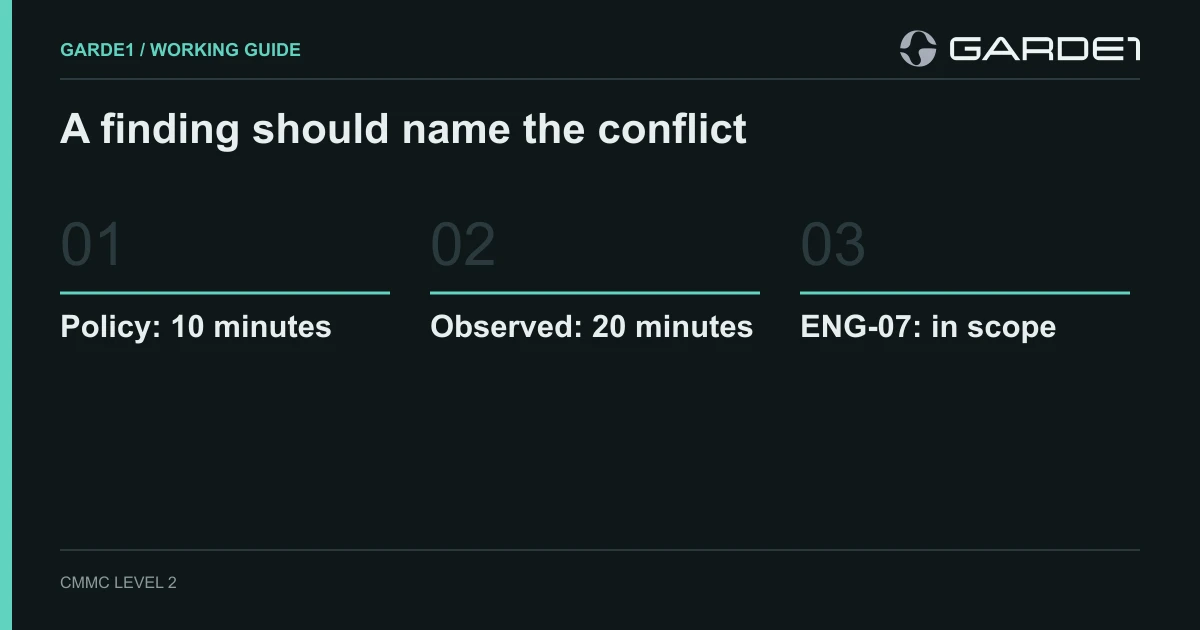
Illustrative example: an approved policy specifies a 10-minute idle lock. An engineering laptop's effective setting is 20 minutes. Those intervals are example organizational settings, not a universal CMMC timeout. The mock should identify the disagreement, its source, the affected device, and whether the applicable session-lock objectives are supported.
Do not conclude solely from a policy file or a configuration template. Check what applies to the device, relevant exceptions, and actual behavior when appropriate. Do not automatically calculate a complete requirement result from one setting without considering the other applicable objectives and evidence.
The relevant requirements and assessment procedures are in SP 800-171 Rev. 2 and SP 800-171A (June 2018). A structured mock should make its reasoning inspectable against those sources.
Six questions to ask a mock-assessment provider
- What environment is included? Request the documented scope, provider responsibilities, relevant populations, and known collection gaps.
- What operating evidence is examined? Distinguish effective settings and completed activities from policy text, installed products, or uploaded filenames.
- How are objectives handled? Ask to see how the applicable assessment objectives support a requirement-level determination. An unexplained overall score hides important details.
- What happens when evidence is missing or contradictory? The report should identify the gap and required follow-up. It should not treat an empty collection as evidence that no problem exists.
- What does the service actually collect? Confirm the supported vendor, product, capability, permissions, and release status. A provider's logo does not mean every control or asset is covered.
- How are fixes verified? Request subsequent evidence and a targeted recheck. A ticket closure alone may not establish that access or configuration actually changed.
For MFA, registration alone does not demonstrate enforcement. Review applicable authentication policies, assignments, exclusions, access paths, and appropriate operating evidence. Similarly, an endpoint policy that exists does not show that every scoped endpoint received it.
What a traceable finding looks like
Illustrative finding: an approved termination record says a contractor's access ended, but a dated effective-access export still shows a group path into the engineering site. The report identifies the two records, affected identity, group path, scope, and relevant objectives. It distinguishes the observed access path from the still-unresolved question of other access routes.
The remediation owner investigates and removes unauthorized access through the approved process. The recheck examines group membership and other relevant paths, such as direct grants, guest identities, application permissions, and sharing links. The report retains the original finding and new evidence, with an explanation of whether the gap is resolved.
The report should not tell an administrator to delete an unfamiliar account merely because ownership is missing. First establish what the identity is, who owns it, whether it is authorized, and what the change could affect.
Separate readiness work from official assessment
Software, an RPO, an MSP, and a C3PAO can perform different roles. Ask which organization performs each contracted service and which result it is authorized to provide. A mock report is not an official certificate, a submitted government record, or a replacement for an affirmation obligation.
For budgeting, distinguish the mock, remediation, continuing operations, and any separately required official assessment. See CMMC readiness and assessment costs. For preparation for an applicable C3PAO engagement, use the assessment-day guide.
Evaluate Garde1 with the same questions
Garde1 provides readiness and mock-assessment tooling. Read the illustrative report, check connector coverage and release status, and compare plan terms. Confirm the capabilities needed for your actual environment rather than assuming that all evidence can be collected automatically.
AI evaluations can vary and depend on the supplied scope and evidence. Findings need review, unsupported facts need follow-up, and manual operating records may be required. Garde1 does not issue CMMC certification. A provider should be willing to show those limitations alongside the useful parts of its report.