
Updated October 6, 2026
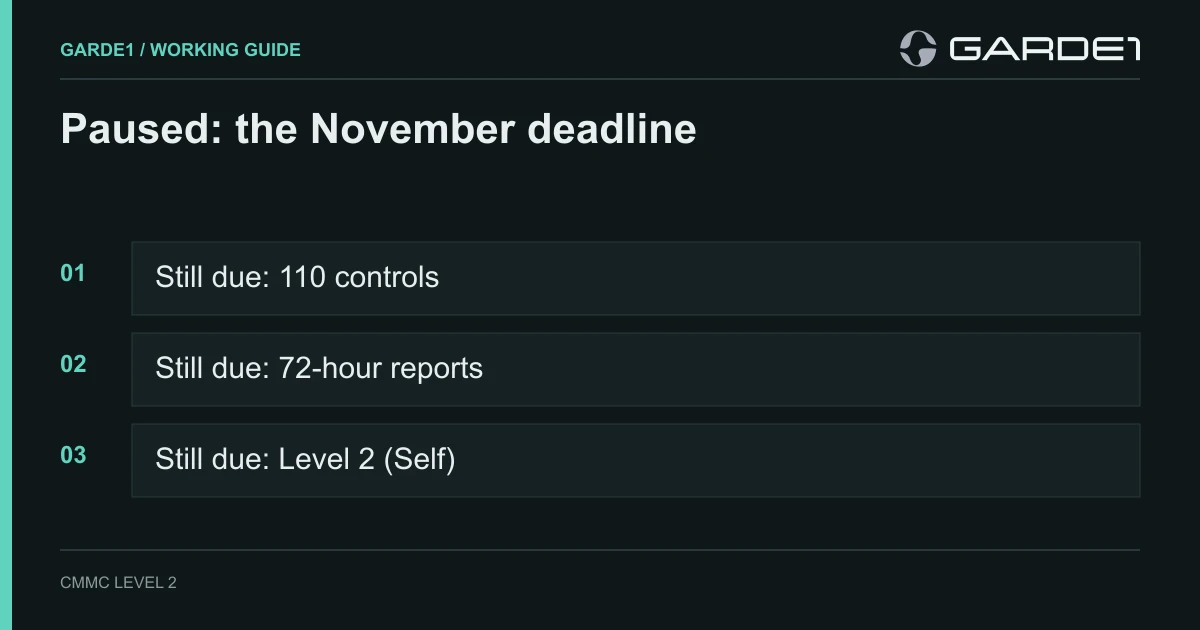
Yes. The pause cancelled one deadline: the November 10, 2026 date when defense contracts would have started requiring a certificate from an outside assessor. It didn't cancel the security rules already in your contracts, it didn't stop self-assessments, and it didn't stop the government from checking your work.
Here's the situation most owners are in right now. You make parts, write software, or provide services for the Department of Defense, directly or through a larger company (your "prime"). Sometime in the past two years someone told you that you needed CMMC, the Pentagon's cybersecurity program for its suppliers. You hired an MSP (managed service provider, the outside IT company) to tighten things up, and maybe you put down a deposit with a C3PAO, one of the accredited firms that perform the official third-party assessment. Then in July you read that CMMC was suspended.
Keep the MSP. Think hard before you cancel the assessor. The rest of this page explains why, what actually changed, and what you owe today.
What CMMC is, in one paragraph
CMMC (Cybersecurity Maturity Model Certification) is how DoD checks that its suppliers protect two kinds of information. FCI (federal contract information) is non-public contract information like purchase orders and pricing. CUI (controlled unclassified information) is the sensitive material: the drawings, specifications, and technical data the government marks as controlled. Protecting FCI takes 15 basic safeguards (Level 1). Protecting CUI takes the 110 requirements in a government standard called NIST SP 800-171 (Level 2). A small set of programs add more (Level 3). Which level you need →
The important thing to know about the pause: the 110 requirements are older than CMMC. Since 2017, any contract carrying the clause DFARS 252.204-7012 has required you to implement them (DFARS 252.204-7012). CMMC was only ever the checking mechanism. The pause slowed the checking. The requirements didn't move.
What happened in July and September
CMMC was being phased in over four years under the program rule, 32 CFR 170.3(e). Phase 1 started on November 10, 2025, when the contract clause took effect (48 CFR final rule). Each later phase starts one year after the one before.
| Phase | Start date | What it adds | Status today |
|---|---|---|---|
| 1 | Nov 10, 2025 | Level 1 (Self) and Level 2 (Self) in contracts | Running |
| 2 | Nov 10, 2026 | Certificates from a C3PAO become the normal award condition for CUI work | Suspended |
| 3 | Nov 10, 2027 | Certificates required at option periods; Level 3 in contracts | Suspended with the schedule |
| 4 | Nov 10, 2028 | CMMC in every contract that involves FCI or CUI | Suspended with the schedule |
On July 13, 2026, the Department of Defense (which now also calls itself the Department of War, so you'll see both names) suspended that schedule. The implementing memo is short and specific (DoW memo, July 13, 2026). While the suspension lasts, program offices may only ask for Level 1 (Self) or Level 2 (Self). They may not ask for a Level 2 certificate from a C3PAO or a Level 3 assessment by DoD's own assessors. The same memo says the department will keep enforcing the 110 requirements "through CMMC Level 1 and CMMC Level 2 self-assessment and select Government-led assessments," and that the cybersecurity requirements in the 7012 clause "remain in effect."
DoD turned the memo into contracting instructions three days later, in Revision 2 of class deviation 2026-O0025 (July 16), and restated them in Revision 3 on September 3 (deviation memo, pages 2–3). A class deviation is a formal instruction that tells every contracting officer to do something different from the published regulation. This one tells them to "remove or revise the CMMC requirements in new and existing solicitations and contracts" in line with the memo, and spells out four things a contractor should care about:
- Requiring activities may include CMMC Level 1 (Self) or Level 2 (Self).
- DFARS 252.204-7012 still requires baseline compliance with NIST SP 800-171 Rev. 2.
- Open solicitations with certificate requirements get amended.
- Existing contracts with those requirements get modified "prior to the exercise of the next option period or through the next scheduled administrative modification."
Nothing in either document repeals the CMMC rule. The program, the levels, and the scoring all remain law. The Cyber AB, the body that accredits assessors, said on July 15 that "all CMMC program elements remain operational and available, to include C3PAO Level 2 certification assessments" (Cyber AB statement).
Your signed contract hasn't changed yet
This is the point most people miss. A memo doesn't rewrite a contract you've already signed. Your contract changes when your contracting officer, or your prime, sends you a modification. An option period is the next year (or next block) of work the government can choose to extend. An administrative modification is a routine paperwork change. The deviation says certificate requirements come out at one of those two moments. Until the paper arrives, you owe what you signed.
So pull your active contracts and subcontracts and read the cybersecurity clauses. You're looking for three numbers. 252.204-7012 means you must protect CUI with the 110 requirements. 252.204-7021 is the CMMC clause, and it names the level and assessment type. 252.204-7019 or 7020 on older contracts means you owe a NIST SP 800-171 Basic assessment score in SPRS (the Supplier Performance Risk System, DoD's database of supplier cyber scores), no more than three years old.
A note for whoever manages your contract files: since February 1, 2026, when the first version of this deviation took effect, new contracts no longer carry 7019 and 7020. It uses 252.240-7997, under which DCMA (the Defense Contract Management Agency) runs Medium and High assessments of your 800-171 implementation, and their results take precedence over your own score (deviation, 252.240-7997). New awards get the self-scored number through 7021 as a Level 2 (Self) status. Older contracts keep asking for the Basic score until someone modifies them. How to file a Level 2 self-assessment →
What 7012 still asks of you every day
If you handle CUI under a 7012 contract, your daily obligations are exactly what they were in June.
You run the 110 requirements on every computer, account, and cloud service that touches CUI. Those include multi-factor login for everyone, encrypted laptops, audit logs you keep and review, patching, malware protection, security training, and a written System Security Plan (SSP) that describes how you do all of it.
You report cyber incidents to DoD within 72 hours of discovering them. Reports go to DC3, the DoD Cyber Crime Center (DC3 DCISE). You can't file without a DoD-approved medium assurance certificate, a digital ID you buy through the ECA program. After a report, you preserve images of the affected systems and the related monitoring data for at least 90 days.
Any cloud service that stores your CUI has to meet the FedRAMP Moderate baseline or its equivalent. FedRAMP is the government's security approval program for cloud providers. And the clause flows down: if you hand CUI to a subcontractor, their contract has to carry 7012 too.
Get the medium assurance certificate this month. If you wait for an incident to learn you need it, you'll be applying for an ID with a 72-hour clock already running. Incident response without a security team →
Should you cancel the C3PAO assessment?
Usually no. Here's how we'd decide.
Keep it if a prime's signed subcontract names a certificate as a deliverable, if you bid on work where the prime prefers certified suppliers, or if you're within a few months of ready anyway. A Level 2 certificate from a C3PAO lasts three years, and the CMMC clause asks for the required level "or higher," so a certificate satisfies any Level 2 (Self) requirement during the pause (deviation, 240.371-3).
Move the date if you're more than six months from ready. An assessor won't fix your gaps, and a failed assessment costs the fee without producing a certificate. Spend the next six months on the fixes, then book it.
Cancel only if none of your contracts involve CUI. In that case you needed Level 1, not a C3PAO, in the first place.
The dollars are real. DoD's own estimate for a small company is $104,670 over three years for a C3PAO certificate with its annual affirmations, against $37,196 for a Level 2 self-assessment over the same period. Both figures cover the assessment and paperwork only, not the cost of closing gaps (32 CFR 170 final rule, cost analysis). What a readiness assessment costs →
If you are weighing how to get the work done during the pause, every route is on one page with its first-year cost and who does the work: Garde1 vs a consultant, Vanta, Secureframe Defense, Drata, Delve, PreVeil and FutureFeed.
The risk that didn't pause
The government can still come after a supplier who says it's secure and isn't. On September 1, 2026, Honeywell Aerospace agreed to pay $2,042,518 to settle False Claims Act allegations that one of its networks didn't meet NIST SP 800-171 between 2020 and 2023 (DOJ press release). The case started with a former employee, who received $375,823 as her share. There was no breach in the announcement. The allegation was that the controls weren't there while the company was being paid.
That's why sorting spending by the pause gets it backwards. Sort it by one question: would you still owe this if no assessor ever showed up? Endpoint management, multi-factor login, log retention, backups, and the MSP who runs them all pass, because 7012 requires what they deliver. The C3PAO fee is the one line item the pause truly made optional, and only if your signed contracts don't require it.
If your prime still wants a certificate by November
Primes flow cybersecurity terms down to you through your subcontract, and some haven't caught up with the deviation. Send their contracts contact a short note:
Our assessed environment is [scope]. Our current SPRS record is [Level 2 (Self) or NIST Basic, with score] dated [date]. Given class deviation 2026-O0025, Revision 3, please confirm whether a C3PAO certificate remains a deliverable under our subcontract and send any modification. We continue to meet our DFARS 252.204-7012 obligations.
Keep their answer with your contract file. More on answering a prime's CMMC letter → and how flowdowns work during the pause →
What could change next
The July memo set up a CMMC Reform Task Force with a 60-day review. DoD received more than 1,100 industry responses, and the CIO, Kirsten Davies, said in September that "compliance doesn't equal security" and that the program weighed hardest on small and medium businesses (DefenseScoop, Sept. 9). As of this update the task force's report hasn't been published.
A report is advice. Changing what contracting officers do takes another deviation, a new memo, or a rule change. And the current deviation still carries the end date of the old schedule: from November 10, 2028, the CMMC clause goes into every contract where you'll handle FCI or CUI on your own systems (deviation, 240.371-5). Plan for the checking to come back in some form.
Common questions
Is CMMC cancelled? No. The rule at 32 CFR part 170 is still in force, self-assessments are still being written into contracts, and C3PAOs are still issuing certificates. One phase of the rollout is on hold.
Was CMMC delayed to 2027? No date has been announced. The suspension has no end date, and nothing in the deviation sets a new start for Phase 2. Anyone quoting a 2027 date is guessing.
Do I still need to post a score in SPRS? Yes, if your contract asks for one. Contracts with 7019 or 7020 need a current Basic score. Contracts with the CMMC clause need a Level 1 (Self) or Level 2 (Self) status, plus an annual affirmation from a senior official.
Is my existing C3PAO certificate still worth anything? Yes. It stays valid for three years with annual affirmations, and it meets any Level 2 (Self) requirement because the clause accepts the required level or higher.
Can a prime still require a certificate from me? Not as a DoD rule on contracts written since July 13; the government's ask of a subcontractor is a self-assessment at the level that fits the information you get. A certificate binds you if it's in a subcontract you signed, or if the prime's own DoD contract still names Level 2 (C3PAO) and hasn't been modified. Anything else is the prime's preference, and you can negotiate it. What a prime can require during the pause →
Can the government still audit us? Yes. The July memo keeps "select Government-led assessments," and DCMA's assessment clause is in the deviation. A DCMA result overrides your own score.
Use the quiet months
Contractors who finish the work during the pause will reach the next deadline, whatever it turns out to be, with nothing left to do but schedule the assessment. Contractors who stop will be starting over with a date on the calendar.
Garde1 is built for the first group. You answer where CUI lives and who touches it, and Garde1 builds your scope, writes the SSP and 14 policies from it, pulls evidence from tools like Entra, Intune, and Google Workspace, and runs a mock assessment against all 110 requirements with your SPRS score. What comes out is a short fix list, blockers first, each with its point value.